National Authority for Tunnels (NAT)
Tunnels
Cairo, Egypt
Cairo Metro Line 2
Project Overview:
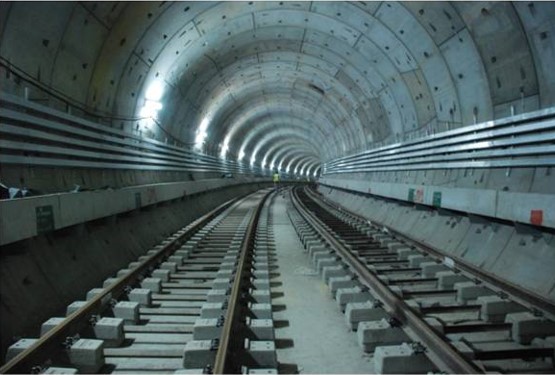
Cairo Metro Line 2, with its foundation stone laid on May 24, 1991, marked a significant advancement in Cairo’s transportation infrastructure. Unlike Line 1, Line 2 was developed as a new dedicated metro line, utilizing advanced tunnel-boring technology and giant tunnel-boring machines of the same generation used in the construction of the Channel Tunnel between England and France.
One of the project’s most remarkable engineering achievements was the construction of tunnels beneath both branches of the Nile. The eastern branch was crossed south of the Qasr El Nil Bridge, in front of the Semiramis Hotel, while a tunnel was constructed beneath the eastern branch near the Sheraton Cairo Hotel.
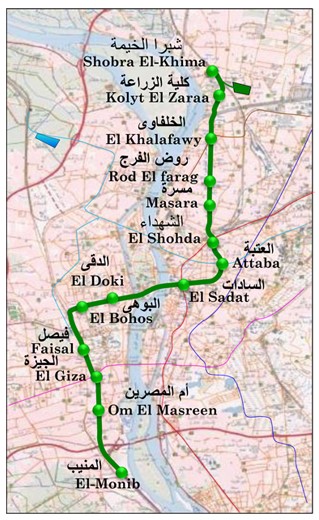
Line 2 extends 21.6 km from Shubra El-Kheima to El-Mounib and comprises 20 stations: 12 underground, 6 surface and 2 elevated. It passes through major transportation and urban centers including Ramses Square, Attaba, Tahrir Square, Dokki and Giza, with a design capacity of approximately 1.76 million passengers.
Opened in five phases:
- Phase 1 (Shubra El-Kheima – Ramses / Al-Shohadaa): 7.7 km, 8 stations, opened in 1996.
- Phase 2 (Ramses / Al-Shohadaa – Tahrir / Sadat): 3 km, 3 stations, opened in 1997.
- Phase 3 (Tahrir / Sadat – Cairo University): 5.5 km, 4 stations, opened in 1999.
- Phase 4 (Cairo University – Umm Al-Masryeen): 2.7 km, 3 stations, opened in 2000.
- Phase 5 (Umm Al-Masryeen – El-Mounib): 2.6 km, 2 stations, opened in 2005.
One of the most demanding sections of Cairo Metro Line 2 was the deep tunnel between Al-Khalfawi and Saint Teresa stations. The combination of groundwater, local soil conditions, and the surrounding urban environment required an unconventional approach at Saint Teresa.
To enable the tunnel boring machine to pass safely through the station area, the station box was filled with water to balance the pressure between the surrounding ground and the station structure. The approach proved successful, allowing the Hatshepsut TBM to pass safely through the station box and continue its excavation.
ECPC’s Scope of Work:
As the first and only producer of tunnel segments in Egypt at the time, ECPC supplied 14,250 meters of segments for all 12 underground stations. This totaled 76,000 precast segments (9,500 rings with a diameter of 8,500mm).